Faceless YouTube channels are entering a new era, and Claude AI is becoming one of the most interesting tools behind this shift. Some newly launched channels are attracting millions of views within their first few weeks, while AI animation is making it possible to produce videos that previously required significant time, technical skills, and expensive production resources.
One particularly impressive example is a faceless channel that reportedly received 4.6 million views on its first video after launching just two weeks earlier. According to estimates from Sollo AI, the channel could have generated approximately $39,000 in advertising revenue.
What makes this development especially interesting is the technology behind these videos. With Claude and Claude Code, creators can potentially reproduce sophisticated animation styles using reference videos and carefully configured workflows.
In this article, we'll explore 10 faceless YouTube channels that have recently gained attention through Claude-style animations. We'll also examine how these channels choose their niches, why their videos attract viewers, and how similar animations can be created without relying on multiple expensive production tools.
It's important to understand that the revenue figures discussed throughout this article are third-party estimates rather than verified earnings. Not every channel listed has an estimated income above $10,000 per month. Nevertheless, these examples offer an interesting look at how AI-assisted animation could change faceless YouTube content creation.
1. Day One Films - Self-Improvement and Motivational Animations
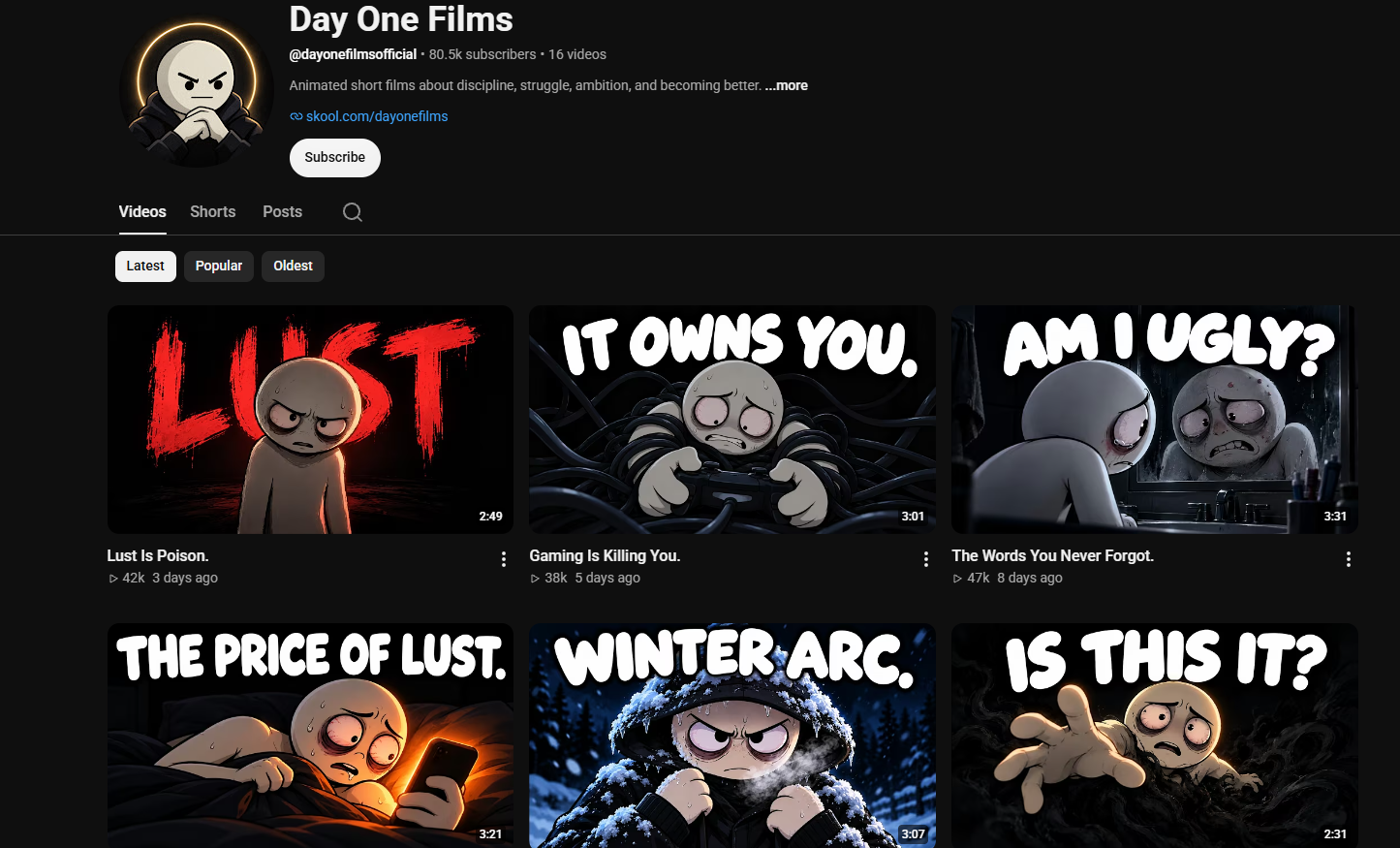
The first channel worth examining is Day One Films, a faceless YouTube channel focused primarily on self-improvement, personal development, and motivation.
During its early publishing period, one of the channel's oldest videos reportedly accumulated 5.3 million views within approximately one month.
What makes Day One Films particularly interesting is its animation style. The videos feature polished visuals that would traditionally require considerable animation experience and production time. However, similar results may now be achievable through Claude Code with the right animation workflow.
According to Sollo AI estimates, the channel could have generated approximately $33,000 in advertising revenue, based on an estimated RPM of around $4 per 1,000 views. One individual video was estimated to be generating approximately $600 per day.
But advertising revenue isn't the only potential income stream.
The channel also promotes a paid community hosted on Skool, priced at $29 per month. With approximately 400 reported members, that represents around $11,600 in potential monthly membership revenue before fees, assuming all members are paying the listed price.
Some of the most interesting details about Day One Films include:
- Content niche: Self-improvement, personal development, and motivational storytelling.
- Video performance: One of its oldest videos reportedly reached 5.3 million views within approximately one month.
- Estimated advertising revenue: Around $33,000, according to Sollo AI.
- Additional monetization: A paid Skool community priced at $29 per month.
- Production approach: Polished animated videos that may be recreated through structured Claude Code workflows.
This example demonstrates how a faceless YouTube channel can become more than a source of advertising income. By combining engaging educational content with a paid community, creators can build additional revenue streams around their audience.
2. IFOLOGY - What-If Scenarios and Animated Explanations
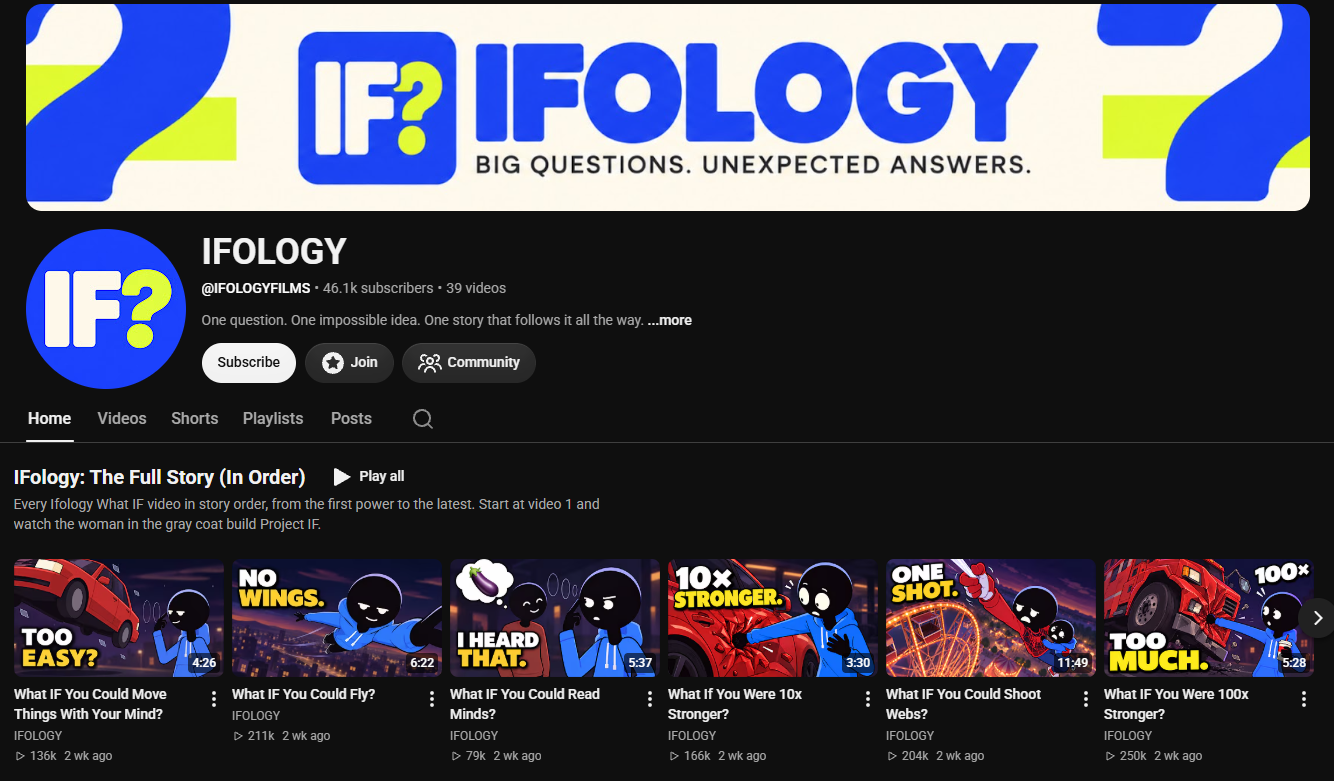
The second channel is IFOLOGY, which focuses on hypothetical scenarios and what-if questions.
This type of content has always been popular on YouTube because it combines curiosity, entertainment, and educational storytelling. Viewers are naturally interested in questions that challenge their understanding of the world.
During its first two weeks of publishing, some of IFOLOGY's early uploads reportedly reached 100,000 and 200,000 views.
Sollo AI estimated that the channel could have generated around $19,000 during its initial two-week period.
One of the most interesting aspects of IFOLOGY is its animation style. The videos appear complex, but the underlying approach can potentially be recreated using Claude Code and a suitable animation setup.
Rather than manually producing every visual element, creators can use AI-assisted workflows to generate animation code, organize scenes, and develop a consistent visual presentation.
The what-if niche is also particularly flexible. It can cover science, human behavior, technology, history, and countless other subjects.
Some of the characteristics that make this niche attractive include:
- Curiosity-driven topics: Hypothetical questions naturally encourage viewers to discover the answers.
- Broad content opportunities: Videos can explore science, history, technology, human behavior, and unusual scenarios.
- Animation-friendly storytelling: Complex ideas can be explained through visual demonstrations.
- Evergreen potential: Many hypothetical questions remain interesting for years.
- Estimated early earnings: Approximately $19,000 during the first two weeks, according to Sollo AI.
This flexibility creates opportunities for creators to develop original concepts without directly copying existing channels.
3. GoDocs - High-Effort Animation With Viral Potential
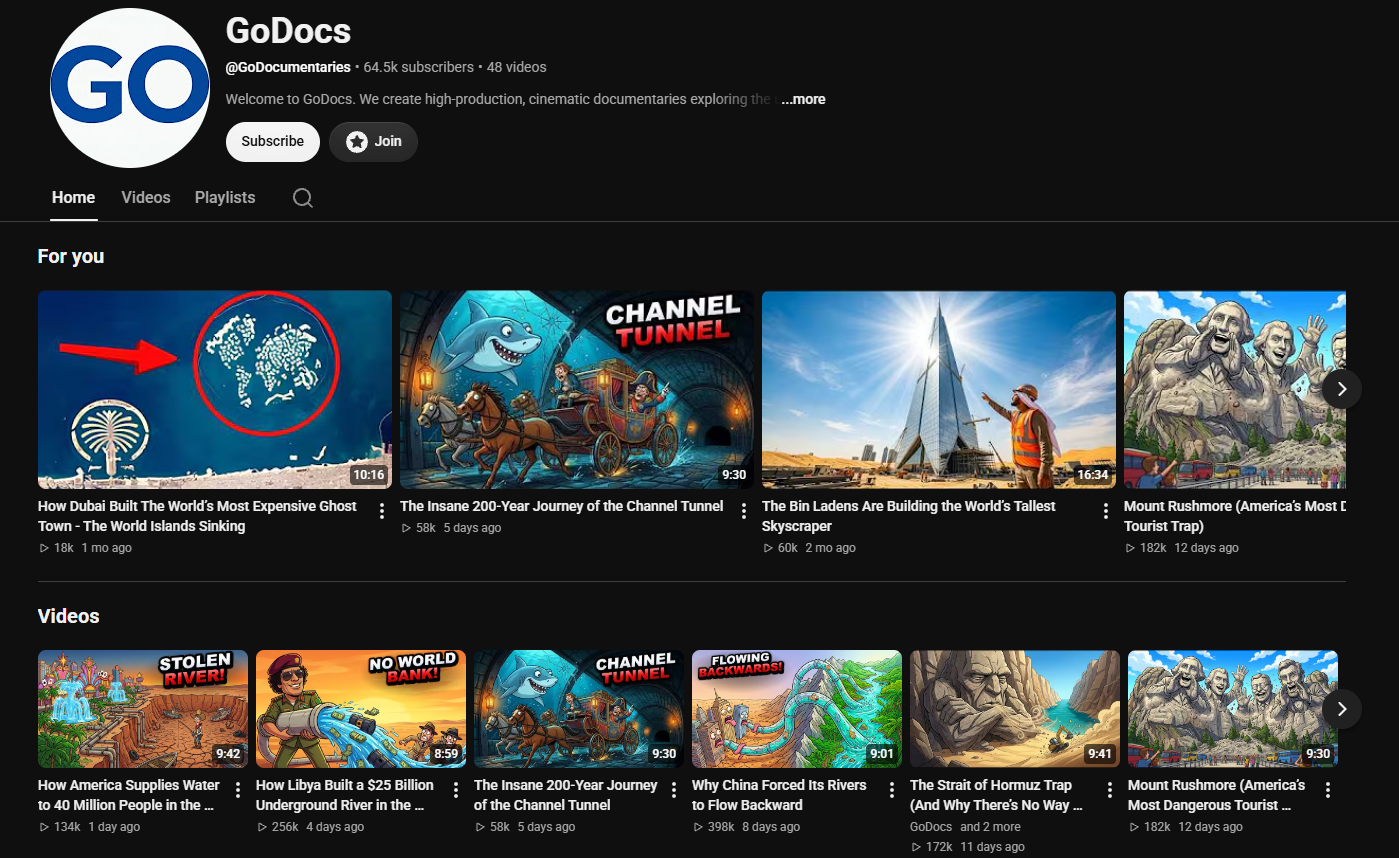
The third channel, GoDocs, provides another example of how animated faceless content can attract attention.
The channel focuses on high-production documentary videos exploring engineering, infrastructure, historical developments, and remarkable construction projects.
Its videos cover subjects such as the Channel Tunnel, the world's tallest skyscrapers, major infrastructure projects, and unusual engineering decisions.
During an early period of growth, the channel reportedly attracted millions of views across its content.
According to Sollo AI, the channel could have generated an estimated $49,000 during a monthly period, using an estimated RPM of approximately $3 per 1,000 views. One particularly successful video was estimated to be earning around $1,000 per day from advertising.
A major reason these videos may perform well is their perceived production quality.
Traditional animation requires time, technical knowledge, and considerable effort. When viewers encounter polished animated content, they often associate it with professional production.
AI-assisted animation can potentially reduce the amount of manual work required to achieve a similar presentation.
Several factors make GoDocs an interesting example of this approach:
- Documentary-focused content: Videos explore engineering, history, infrastructure, and large-scale projects.
- High perceived production value: The animation resembles content that would traditionally require considerable manual work.
- Estimated monthly earnings: Approximately $49,000, based on Sollo AI calculations.
- Production efficiency: AI-assisted animation may reduce some of the technical work involved in creating visuals.
- Viewer experience: Consistent, polished animation can make videos feel more professional and engaging.
However, the quality of the final result remains essential.
Videos that appear rushed, inconsistent, or obviously AI-generated may struggle to retain viewers. High-quality animation, engaging storytelling, and strong video concepts are still necessary.
GoDocs illustrates the potential value of combining efficient production with visuals that audiences find entertaining and worth watching.
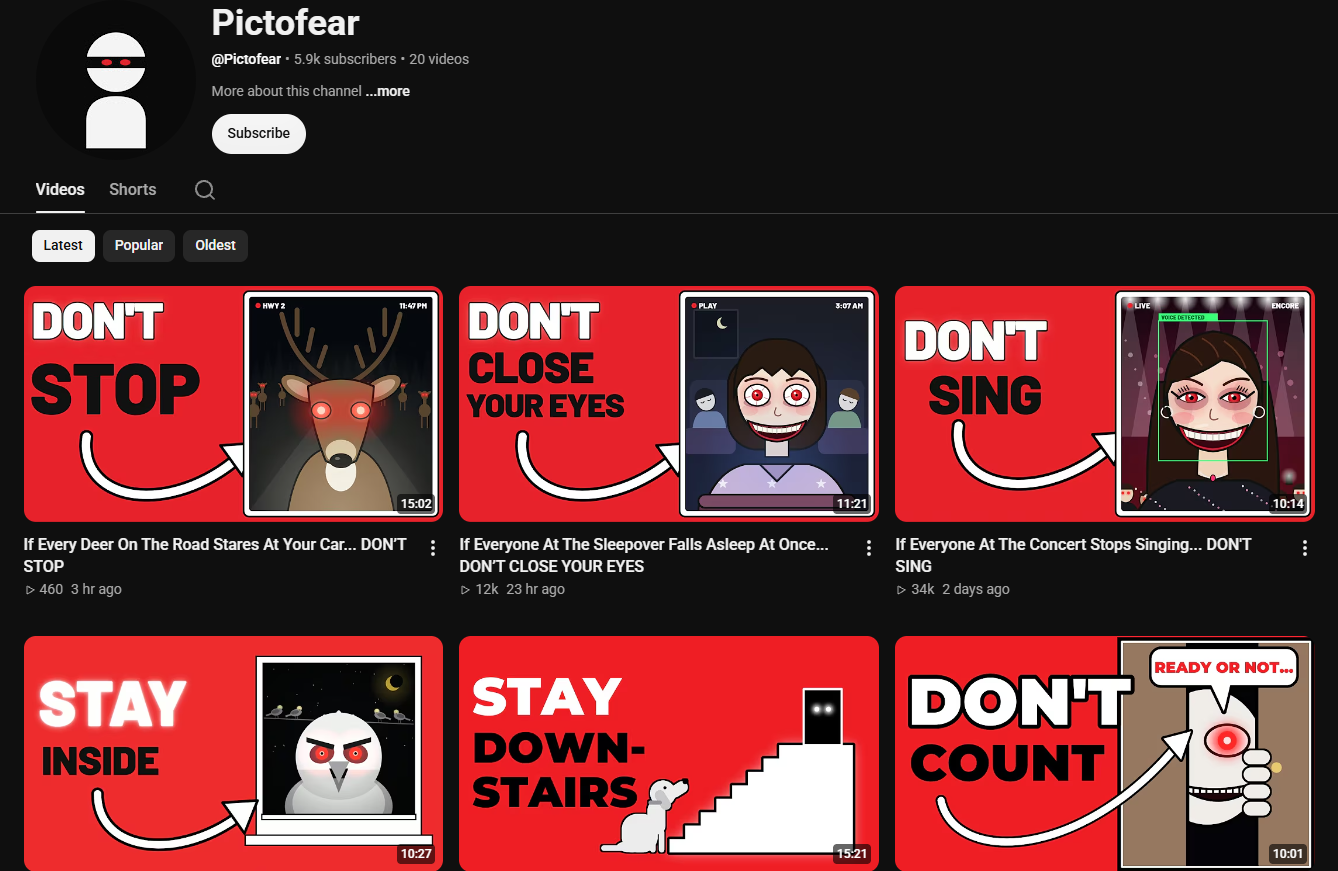
4. Pictofear - Strange Scenarios and Suspenseful Storytelling
Not every successful faceless animation channel needs to focus on education or motivation.
Pictofear takes a different approach by using unusual, unsettling, and curiosity-driven scenarios.
One example of the channel's unusual video concepts involves a warning about a dog hiding under a bed at 2:00 a.m.
This type of title immediately creates curiosity. It presents a strange situation, introduces a sense of danger, and encourages viewers to discover what happens next.
During its initial publishing period, the channel reportedly began attracting attention within its first 12 days.
Sollo AI estimated that the channel could have generated approximately $3,000 during that initial period.
Although the estimated earnings were lower than those of some other channels on this list, Pictofear demonstrates something important about niche selection.
Animated faceless videos don't have to follow the same familiar formats.
The channel's approach relies on several recognizable storytelling elements:
- Unusual scenarios: Strange situations make viewers curious about what might happen.
- Suspenseful titles: Unexpected warnings encourage audiences to click and learn more.
- Mystery-driven storytelling: The narrative can gradually reveal information to maintain interest.
- Animated presentation: Visual storytelling can make fictional or unusual scenarios more immersive.
- Distinctive niche positioning: The content differs from conventional educational and motivational channels.
Suspense, horror-inspired storytelling, unusual warnings, and mysterious situations can all provide opportunities for creators who understand how to build curiosity.
The animation style supports the story, but the central attraction is the viewer's desire to understand the strange scenario presented in the title.
5. Jeremy Bearimy - Premium-Looking Animation and Distinctive Thumbnails
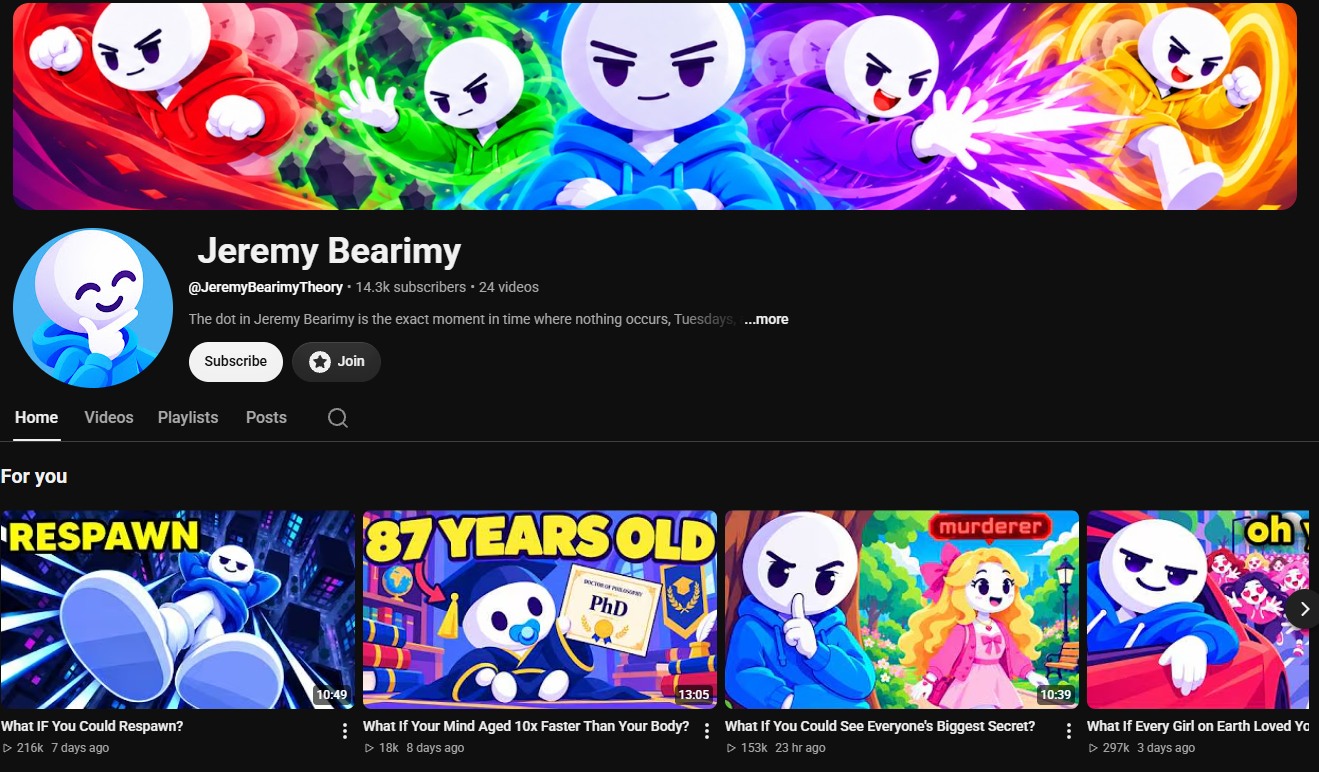
The fifth channel is Jeremy Bearimy, which stands out for its polished animation and distinctive thumbnail design.
The channel explores imaginative what-if scenarios, often involving unusual abilities, hypothetical situations, and creative storytelling.
During its first two weeks of publishing, its initial uploads reportedly attracted approximately 300,000 and 500,000 views.
Sollo AI estimated that Jeremy Bearimy could have generated around $24,000 in advertising revenue during that early period.
One notable characteristic is the channel's visual presentation.
The thumbnails appear carefully designed, with a consistent style that gives the channel a professional identity.
This matters because thumbnails are often the first interaction viewers have with a video. Even excellent content can struggle if the title and thumbnail fail to generate interest.
Jeremy Bearimy combines attractive thumbnail design with an animation style similar to those seen across other emerging Claude-assisted channels.
The channel demonstrates several important aspects of visual branding:
- Professional thumbnail design: Strong visuals help videos stand out in YouTube recommendations.
- Consistent animation style: A recognizable presentation can strengthen the channel's identity.
- Early audience interest: Initial uploads reportedly reached approximately 300,000 and 500,000 views.
- Long-form content strategy: The channel focuses on regular YouTube videos rather than relying on Shorts.
- Estimated advertising revenue: Around $24,000 during its early publishing period, according to Sollo AI.
Another notable characteristic is the channel's focus on long-form YouTube videos rather than YouTube Shorts.
While YouTube Shorts can be useful for discovery and audience development, long-form content can offer different advertising and monetization opportunities.
For channels built around detailed animations and storytelling, long-form videos may be particularly suitable.
6. One Small If - Building a Recognizable Visual Brand
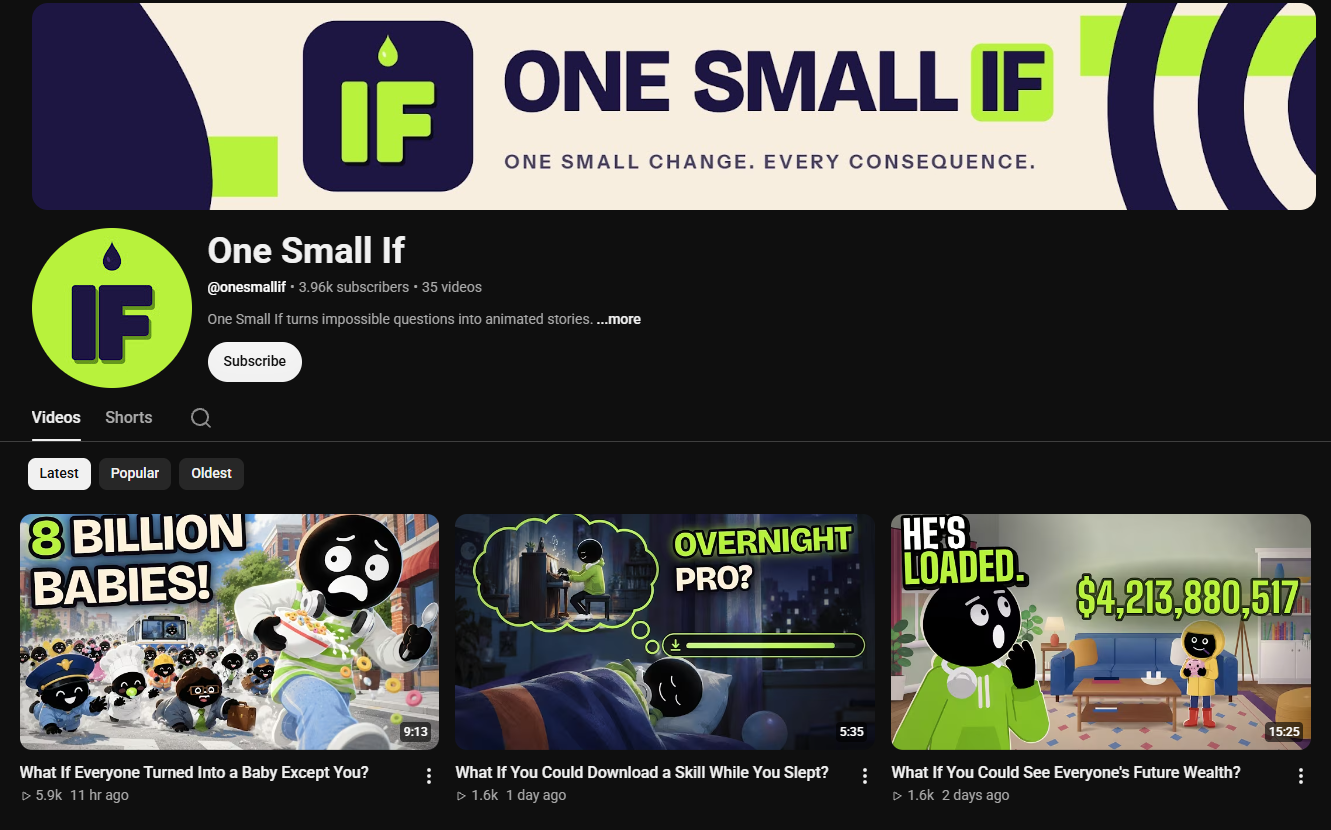
The sixth channel is One Small If, another relatively new channel centered on animated content.
The channel explores hypothetical questions and impossible scenarios, turning imaginative ideas into animated stories.
During its first two weeks of publishing, Sollo AI estimated that the channel could have generated around $2,000.
Although this figure was lower than several other examples, One Small If offers an important lesson about branding.
The channel uses a recognizable accent color throughout its visual presentation.
This creates consistency across thumbnails and animations, making the channel easier for viewers to recognize.
A consistent visual identity can be especially valuable in a competitive niche where multiple creators are experimenting with similar animation techniques.
Instead of relying entirely on the novelty of AI-generated visuals, creators can establish their own recognizable style through:
- A consistent color palette across thumbnails and videos.
- Recurring characters or visual elements that help establish familiarity.
- Similar typography and composition to maintain a professional appearance.
- A recognizable animation style that viewers associate with the channel.
- Consistent visual storytelling that makes individual videos feel like part of the same brand.
These elements help transform a collection of individual videos into a recognizable brand.
As AI-assisted animation becomes more accessible, distinctive branding may become increasingly important for channels trying to stand out.
7. Manifesting - What-If Scenarios and Imaginative Storytelling
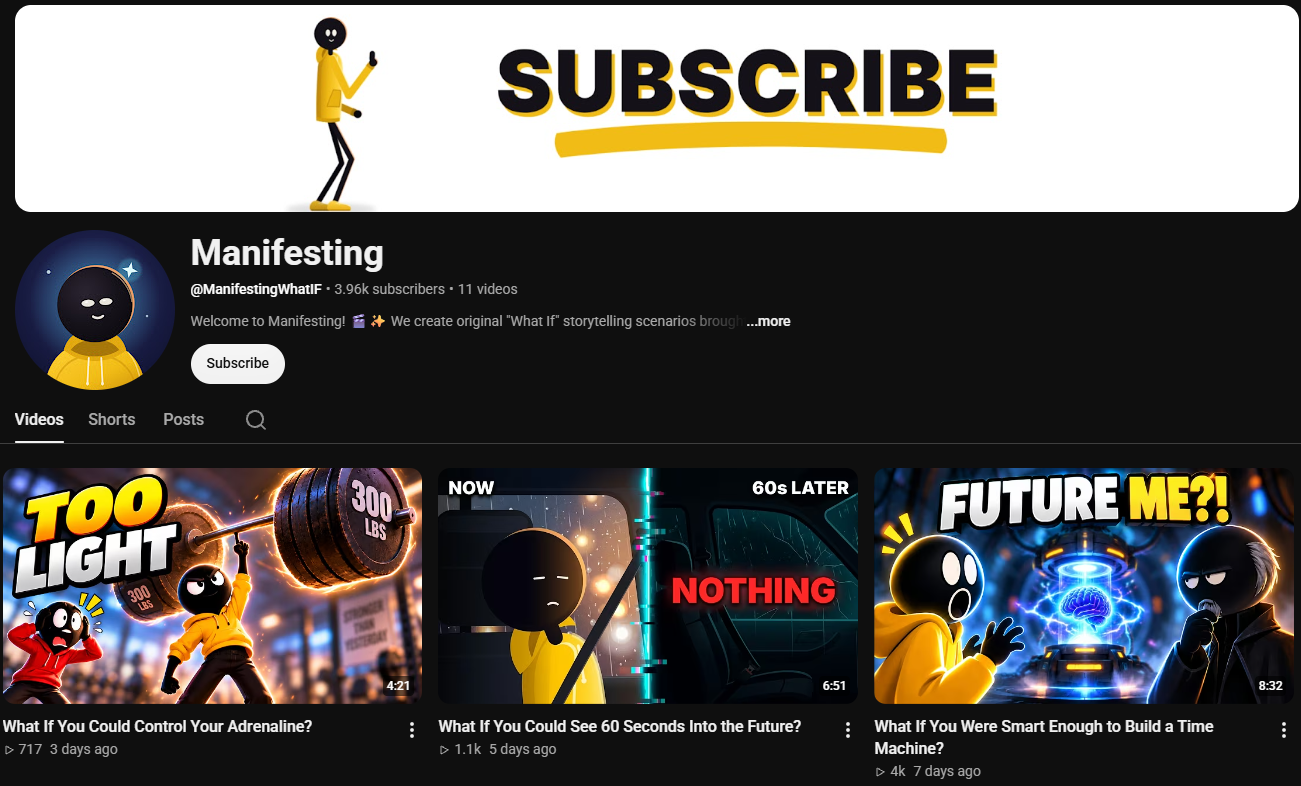
The seventh channel, Manifesting, focuses on imaginative what-if scenarios presented through animated storytelling.
Rather than concentrating on traditional motivational content, the channel explores hypothetical abilities, unusual situations, and questions about what might happen if certain things were possible.
Examples include controlling adrenaline, seeing into the future, and developing extraordinary intellectual abilities.
During its early publishing period, the channel reportedly attracted significant attention, with its second upload reaching approximately 800,000 views.
The channel demonstrates how imaginative scenarios can be combined with modern animation techniques to create engaging faceless videos.
Hypothetical questions are already an established YouTube content category, but changing the visual presentation can make familiar concepts feel different.
Rather than relying on stock footage, generic backgrounds, or conventional editing techniques, creators can use animation to illustrate unusual situations and communicate ideas visually.
This approach can make abstract topics more engaging.
The channel's format highlights several opportunities within the what-if niche:
- Established audience interest: Hypothetical questions and imaginative scenarios have broad entertainment appeal.
- Animated explanations: Visual storytelling can make unusual concepts easier to understand.
- Different presentation styles: Familiar topics can feel fresh when presented through distinctive animations.
- Strong early engagement: The channel's second video reportedly attracted approximately 800,000 views.
- Repeatable content themes: Superhuman abilities, futuristic technology, impossible situations, and alternative realities can support numerous video ideas.
Manifesting shows how an established content category can potentially attract new attention when presented through a different animation style.
8. Monk Mode Films - Discipline, Habits, and Personal Development
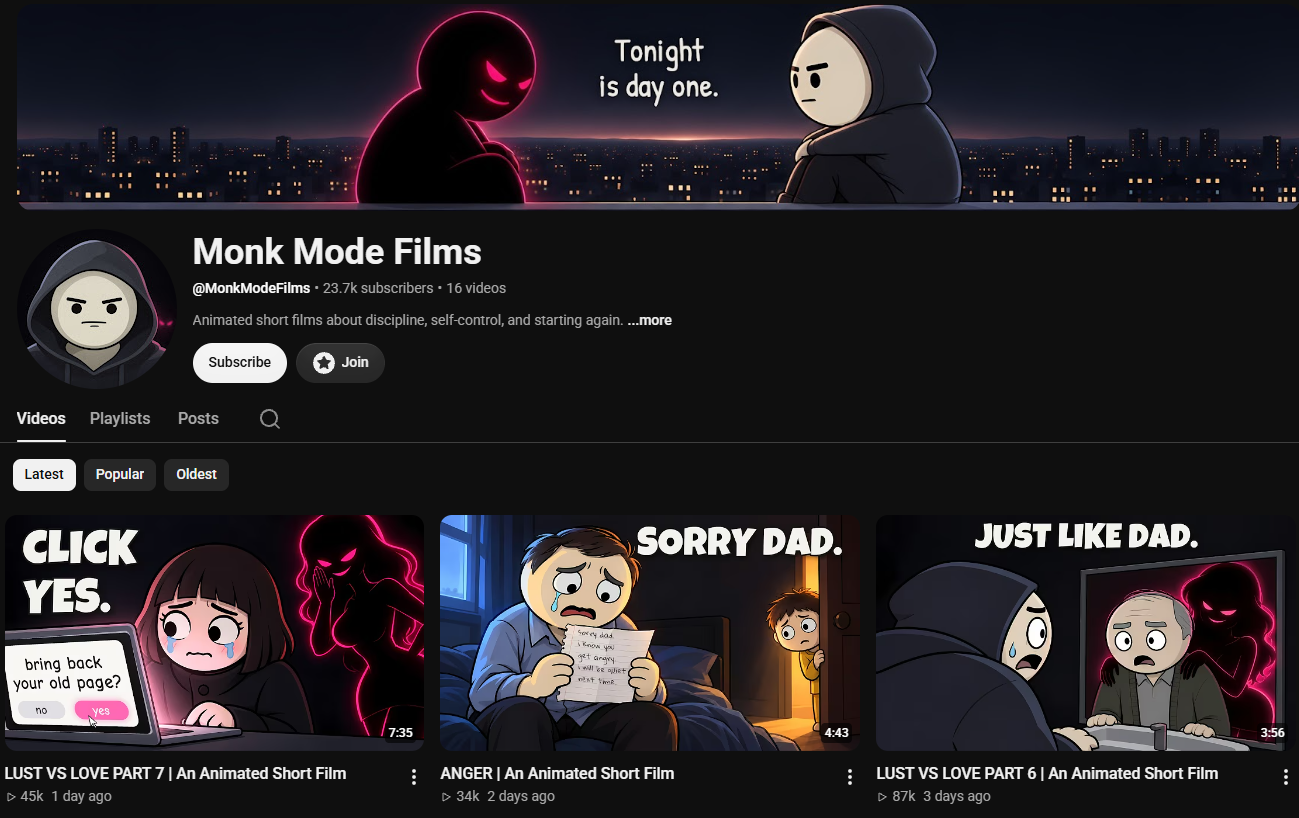
Monk Mode Films follows a direction similar to Day One Films, focusing primarily on discipline, self-improvement, and overcoming bad habits.
During its early publishing period, the channel reportedly attracted millions of views across some of its most successful videos.
Sollo AI estimated that the channel could have generated around $8,000 during its initial two-week period.
The content appears particularly focused on helping viewers develop better habits and eliminate behaviors that interfere with their personal goals.
This is a well-established topic on YouTube, but the channel uses animated storytelling to communicate its ideas.
The combination of self-improvement advice and polished animation can make the content feel more engaging than traditional motivational videos.
Several characteristics help explain the appeal of this approach:
- Focused audience: Content aimed at viewers interested in discipline, habits, and personal development.
- Relatable subjects: Many videos explore challenges that audiences may recognize from their own lives.
- Animated storytelling: Visuals can make advice more memorable and engaging.
- Established content demand: Self-improvement remains a recognizable category on YouTube.
- Estimated initial revenue: Approximately $8,000 during its early publishing period, according to Sollo AI.
It also demonstrates that creators don't necessarily need to invent an entirely new niche.
Instead, they can explore existing subjects that already have an audience and introduce a different approach to visual storytelling.
The key is to provide original value rather than simply reproduce another creator's work.
9. Final Sight - Viral Mystery and Unusual Warning Videos
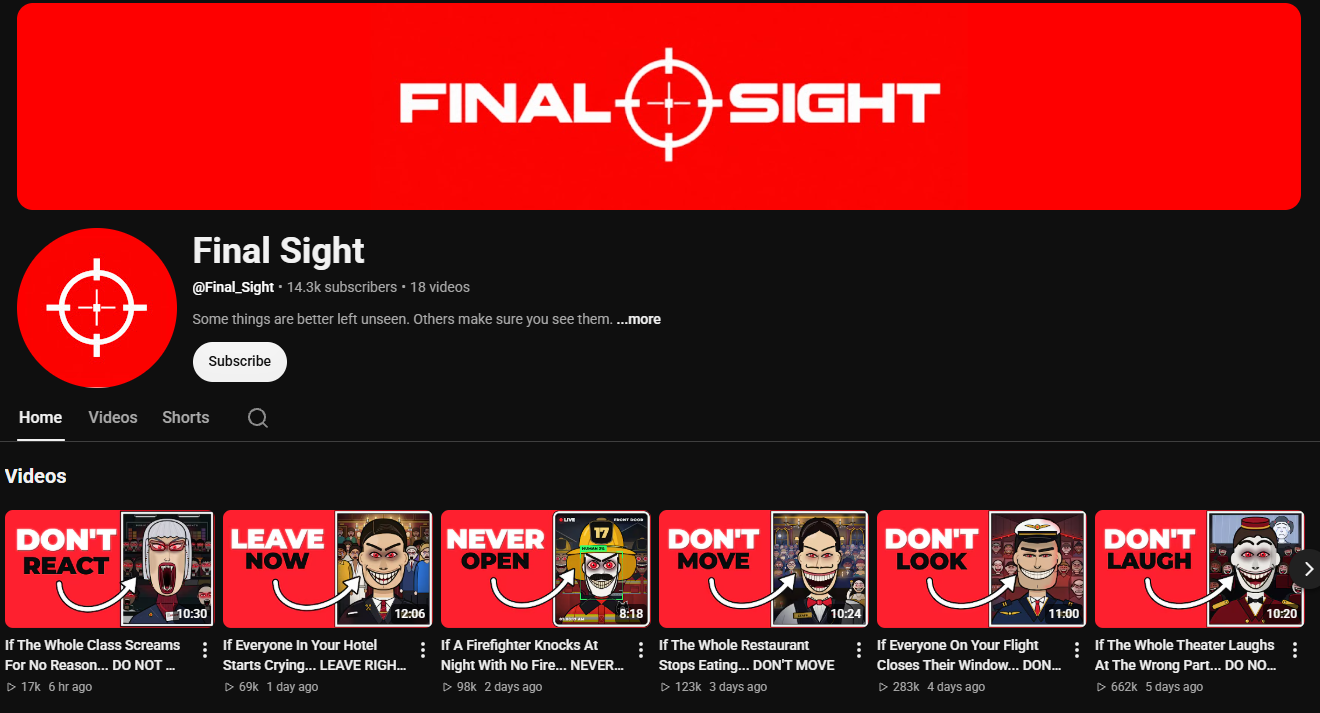
The ninth channel, Final Sight, uses unusual scenarios and mysterious warnings to attract viewers.
One example of the channel's curiosity-driven content involves an unexpected warning about seeing a deer outside a window.
Like Pictofear, Final Sight uses strange situations to create an immediate curiosity gap.
Viewers are presented with an unexpected warning and want to understand the reasoning behind it.
During its first 12 days of publishing, the channel reportedly attracted significant attention.
Its first video reportedly reached approximately 400,000 views, while the next attracted around one million views.
Sollo AI estimated that one of its videos could have been generating approximately $200 per day.
The overall channel was estimated to have generated around $17,000 during its first 12 days.
This would represent more than $1,000 per day on average, although the figure remains an estimate rather than verified revenue.
Final Sight combines several elements that can make mystery-based videos attractive:
- Curiosity-focused titles: Unexpected warnings encourage viewers to discover the explanation.
- Unusual storytelling concepts: Strange scenarios differentiate the content from conventional educational videos.
- Rapid early growth: The first two videos reportedly reached 400,000 and one million views.
- Strong estimated monetization: Sollo AI calculated approximately $17,000 in potential revenue during the initial 12-day period.
- Consistent animated presentation: A recognizable visual style supports the channel's storytelling format.
Final Sight is an interesting example because its appeal doesn't depend entirely on the animation technology.
The video concepts themselves are designed to generate curiosity.
The titles suggest that something unusual or dangerous is happening, while the animation provides a visual format for exploring the scenario.
This combination of intriguing titles, suspenseful storytelling, and consistent visuals can be effective for attracting attention.
10. Awaken - Millions of Views From Only Three Uploads
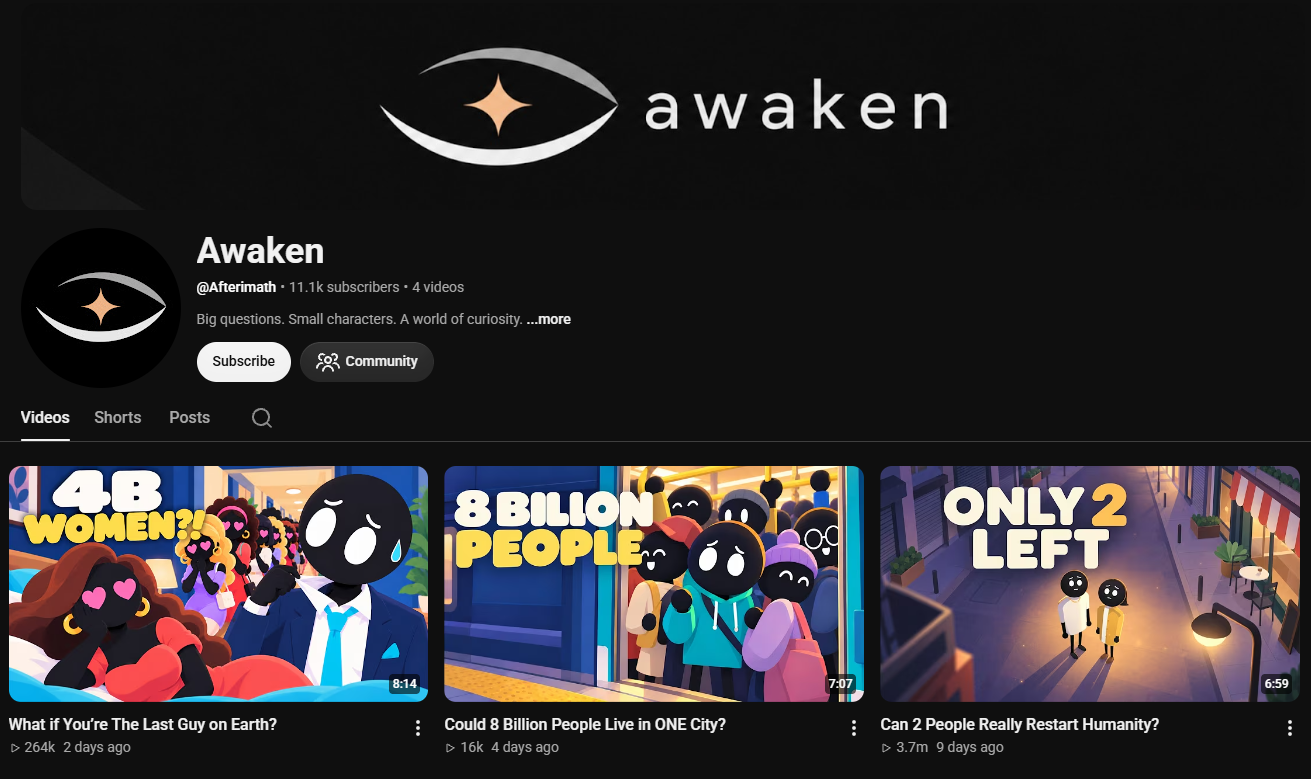
The final channel is Awaken, which had published only three videos during an early period of rapid growth.
The channel focuses on large hypothetical questions involving humanity, population, and unusual situations.
During its first week of publishing, its initial video reportedly attracted approximately 2.9 million views.
That is a significant result for such a small publishing history.
Awaken illustrates how quickly a new channel can gain visibility when a video connects with an audience.
Several details make the channel particularly interesting:
- Recent launch: The channel reportedly achieved substantial attention during its first week.
- Limited content library: Only three uploads were available during its initial growth period.
- First-video performance: Its first upload reportedly attracted 2.9 million views.
- Rapid audience discovery: A new channel can potentially gain significant exposure without an extensive publishing history.
- Long-term uncertainty: Early viral success doesn't necessarily guarantee consistent future performance.
However, a successful first upload doesn't guarantee long-term growth or sustainable revenue.
Channels still need to maintain content quality, develop a recognizable identity, and consistently produce videos that viewers want to watch.
The broader lesson from Awaken and the other channels is that AI-assisted animation may lower some of the technical barriers associated with producing professional-looking faceless content.
But the underlying principles of YouTube success remain the same: strong ideas, compelling titles, engaging storytelling, and effective audience retention.
How to Choose a Profitable Faceless YouTube Niche
After examining these channels, the next question is how to choose a niche without directly copying existing creators.
One approach to identifying promising content opportunities is a strategy known as style remixing.
The concept is relatively straightforward.
Instead of trying to invent a completely new topic, creators can study videos that performed exceptionally well in the past and develop original content around similar audience interests using a different visual style.
YouTube has existed for more than 20 years, and millions of videos have already demonstrated audience demand for particular subjects.
A video published one year ago, five years ago, or even ten years ago may reveal a topic that still interests viewers today.
The opportunity is to explore that subject with a fresh presentation, updated information, and original storytelling.
For example, an educational video originally produced using traditional 2D animation might later inspire an AI-avatar explanation.
Another creator could then explore the same broad subject through Claude-assisted animation.
The subject remains interesting, but the presentation changes.
How Style Remixing Works
The strategy involves studying successful videos and identifying opportunities to develop something original around a similar subject.
A practical approach includes:
- Researching proven video ideas: Find older videos that attracted substantial attention and still cover relevant topics.
- Understanding audience interest: Identify the question, problem, or curiosity that made the original subject appealing.
- Choosing a different visual presentation: Explore whether animation could make the topic more engaging.
- Developing an original script: Add new research, explanations, examples, and storytelling rather than copying existing content.
- Creating a distinctive visual identity: Use consistent colors, characters, and animation techniques to establish a recognizable brand.
An interesting example involves a video published by Vsauce on YouTube exploring what would happen if everyone on Earth jumped at the same time.
The subject has been revisited by different creators over the years, including through newer animated formats.
One more recent animated interpretation reportedly attracted approximately 250,000 views within nine days of publication.
This demonstrates the value of studying proven audience interests.
However, style remixing should not mean copying scripts, characters, animations, or other protected creative elements.
The more sustainable approach is to use successful topics as evidence of audience demand, then create a genuinely original video with its own research, script, examples, and visual identity.
Finding Your Own Opportunity
When evaluating a potential niche, creators should consider several factors.
- Audience demand: Have similar subjects attracted meaningful viewership in the past?
- Content longevity: Can the niche support dozens of original video ideas rather than only one successful upload?
- Visual potential: Can animation make the subject more entertaining, understandable, or engaging?
- Brand differentiation: Can the channel establish a distinctive identity through its colors, characters, and storytelling?
- Monetization opportunities: Does the audience support advertising revenue, sponsorships, products, or community memberships?
The objective is not simply to find another channel that has gone viral.
It's to identify a subject with proven interest and build a distinctive content strategy around it.